The best submerged fish tank filter choices deliver reliable mechanical, biological, and chemical filtration while keeping water clear and oxygenated. This guide focuses on compact to large internal submersible filters suited for freshwater and saltwater setups. It highlights five solid options, explains who each is best for, and notes any limitations. Perfect for hobbyists seeking easy-to-maintain, space-saving filtration that supports healthy fish and plants.
| Product | Tank Range | Key Benefit |
|---|---|---|
| NICREW Aquarium Internal Filter | 2–5 Gallon | Compact, strong biological filtration for tiny tanks |
| AquaMiracle 3-Stage Filter | 10–40 Gallon | Three-stage filtration with see-through housing |
| TARARIUM 300GPH Internal Filter | 55–150 Gallon | High flow and multi-function 4-in-1 design |
| TARARIUM UV Filter for 20–75 Gallon | 20–75 Gallon | U-V light adds water whitening and disinfection |
| MARINELAND Penguin Bio-Wheel | Various sizes | Rotating Bio-Wheel for strong biological filtration |
NICREW Aquarium Internal Filter — 2 to 5 Gallon

Best for ultra-compact setups, this NICREW internal filter provides effective biological filtration in 2–5 gallon tanks. Its fine filter foam traps debris and fish waste while absorbing odors. It supports abundant air bubbles and adequate water flow, aiding oxygenation and circulation. Use this when you want a simple, low-power solution for small bowls and nano-tanks.
- Best for tiny tanks or desktop setups with limited space.
- Clear advantage is continuous biological filtration for stable water parameters.
- Limitation: 40 GPH may be insufficient for larger or heavily stocked nano-tanks.
AquaMiracle 3-Stage In-Tank Filter

Choose this for medium tanks from 10 to 40 gallons. It features three filtration stages (coarse, carbonized, and fine sponge) to remove debris, odors, and fine particles, while keeping water clear. The transparent housing makes it easy to inspect filter media. Best for hobbyists seeking a robust, visible filtration system with straightforward maintenance.
- Best for tanks around 20–30 gallons with moderate bioload.
- Better for users who want easy media inspection and multi-stage filtration.
- Limitation: Some users may want larger media capacity for heavily stocked setups.
TARARIUM Crystal 300GPH Internal Filter

Best for larger community tanks within 55–150 gallons, this Tararium model provides high flow and a robust biochemical filtration system. It uses a black biochemical sponge to reduce odor and yellowing, while decomposing waste. It runs quietly with silicone cushioning suction cups for a calmer environment. It’s a solid pick for mid-to-large tanks that need stronger circulation and odor control.
- Best for larger tanks needing consistent flow and odor reduction.
- Better for setups requiring reliable silent operation.
- Limitation: Higher flow may cause stronger currents affecting shy or small fish; adjust flow as needed.
TARARIUM U-V Filter for 20–75 Gallon

Best for 20–75 gallon tanks that benefit from water whitening and disinfection alongside filtration, this unit combines a 254nm U-V light with a two-stage filtration system. Separate switches allow independent control of the pump and UV light. Choose this if you want both filtration and some degree of water treatment to reduce algae and pathogens.
- Best for tanks where algae control and clearer water are priorities.
- Better for users who want independent control of filtration and UV functional light.
- Limitation: UV exposure requires proper handling; ensure the unit is powered and maintained as directed.
MARINELAND Penguin Bio-Wheel Power Filter
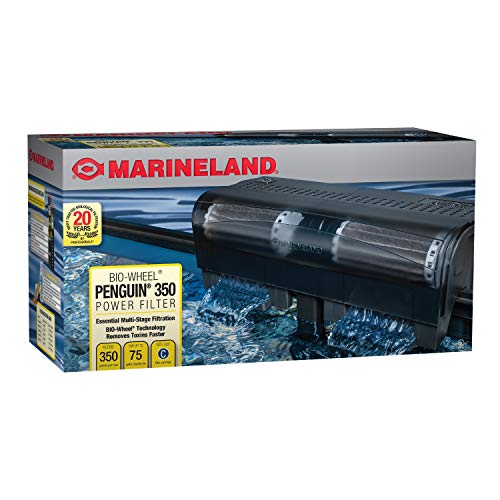
Best for multi-stage filtration in moderate tanks, this traditional Marineland filter features a rotating Bio-Wheel that provides efficient biological filtration in a compact form. It delivers mechanical, chemical, and biological filtration in a single unit and is well-suited for users seeking a proven, maintainable system with familiar brand reliability.
- Best for standard to moderately sized community tanks.
- Better for those who value passive biological filtration via the Bio-Wheel.
- Limitation: Some setups may require careful wheel maintenance to avoid clogging.
TARARIUM 260GPH Internal Filter
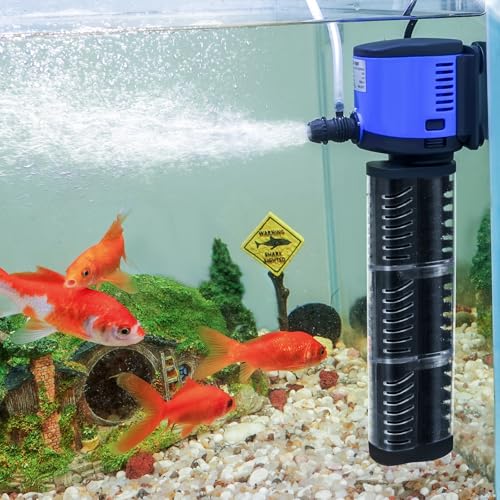
Best for mid-to-large tanks, this Tararium 260GPH unit offers a robust 3-stage filtration with a clear casing to easily spot when media needs cleaning. The 400 GPH pump variant for similar lines provides strong water movement and wave-making capabilities, making it a good choice for dynamic aquariums that benefit from visible dirt detection and active circulation.
- Best for tanks needing noticeable water movement and easy dirt detection.
- Better for hobbyists who want straightforward maintenance with visible media checks.
- Limitation: Might be overkill for small or lightly stocked tanks.
Buying Guide: Key Considerations For Submerged Filters
- Tank size compatibility: Match the filter’s recommended tank range to your aquarium to ensure adequate flow without creating excessive currents for shy fish.
- Filtration stages: Decide between single-stage, multi-stage, and added features like carbon media or UV control based on water quality goals and odor control needs.
- Flow rate and wave generation: Higher gph improves turnover and oxygenation but can stress small or long-finned species. Look for adjustable or multi-speed options if available.
- Media accessibility: Transparent or easy-to-access media helps with quick maintenance. Check if sponges and cartridges are replaceable and affordable.
- Noise and mounting: Internal submersible units should minimize vibration and noise. Consider models with silicone cushions or quiet operation claims for living spaces.
- Installation and maintenance: Look for simple installation steps, low maintenance requirements, and user-friendly cleaning access to ensure long-term reliability.
Frequently Asked Questions
- What is a submerged filter best used for? — It is ideal for providing mechanical, biological, and chemical filtration while occupying minimal surface space in the tank.
- How often should I replace filter media? — Replacement frequency depends on media type and tank bioload; follow manufacturer guidelines and monitor water clarity and odor.
- Can a filter be too powerful for a small tank? — Yes, excessive flow can stress small or delicate fish; choose adjustable or low-flow models for nano tanks.
- Do UV filters eliminate all algae? — UV can reduce free-floating algae and improve clarity, but it is not a sole solution for all algae problems; combine with proper maintenance.
- Is a submersible filter suitable for saltwater? — Yes, many submersible filters operate in both freshwater and saltwater setups; ensure compatibility with saltwater conditions and materials.
- What maintenance tasks are essential? — Regularly inspect media, clean sponges, and verify seals and tubing to maintain consistent flow and filtration.