This guide presents top aquarium heater options to help maintain stable water temperatures in both freshwater and saltwater tanks. Below, five reliable submersible heaters are highlighted with key features, suitability, and safety protections. A concise buying guide Helps compare these models across major considerations like wattage, safety features, and ease of use.
| Product | Brand | Wattage Range | Tank Size Suitability | Link |
|---|---|---|---|---|
| HANLESHUKA Submersible Aquarium Heater | HANLESHUKA | 100W/200W/300W/500W | 10–75 gallons | Product Link |
| HiTauing Aquarium Heater | HiTauing | 300W/500W | 40–75 gallons | Product Link |
| hygger Aquarium Heater | hygger | 300W/500W/800W/1000W | 40–80 gallons | Product Link |
| Orlushy Submersible Aquarium Heater 300W | Orlushy | 300W | 40–55 gallons | Product Link |
| Orlushy Submersible Aquarium Heater 500W | Orlushy | 500W | 40–75 gallons | Product Link |


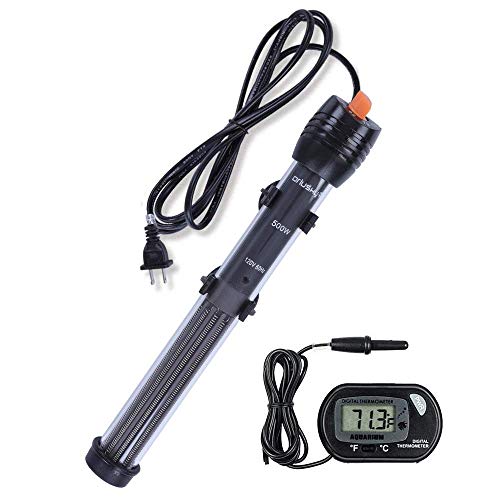
HANLESHUKA Submersible Aquarium Heater
This explosion-proof heater uses quartz glass tubes and nickel-chromium heating wires for safe, rapid heating. Available in 100W, 200W, 300W, and 500W, it fits tanks from about 10 to 75 gallons. The device is designed for versatile use in freshwater and saltwater environments. An automatic on/off system helps maintain stable temperatures with minimal supervision. The durable ABS shell adds protection against accidental contact and scalding. Temperature range and exact control are selected via standard settings along with a simple mounting system for quick setup.
HiTauing Aquarium Heater

The HiTauing unit offers 300W and 500W options with smart leaving-water protection. It is designed for 40–75 gallon tanks, using a quartz glass heater rod and a robust ABS shell to resist impacts. The thermostat allows precise temperature control, and the device includes automatic shut-off when the water reaches the target temperature. A user-friendly cord length and mounting assembly support straightforward installation, suitable for both freshwater and seawater setups. The dual protection features help prevent overheating and ensure safety during operation.
hygger Aquarium Heater
The hygger line covers 300W, 500W, 800W, and 1000W models designed for larger tanks, typically 40–80 gallons. It features an intelligent digital LED controller with adjustable temperature ranges (59℉-93℉) and automatic shut-off upon reaching the set temperature or if overheating/low water is detected. The heater is built with explosion-proof quartz glass and a protective ABS shell. It provides precise readings and alarms to indicate issues, helping maintain a stable aquarium environment with minimal maintenance.
Orlushy Submersible Aquarium Heater 300W
This 300W heater is designed for 40–55 gallon tanks and uses 2mm thickened quartz glass for added strength in both freshwater and saltwater environments. The unit includes two suction cups and a simple control knob for easy temperature adjustments in small increments. It supports reliable, consistent heating while remaining compact enough for a variety of tank layouts. The included hardware and robust construction emphasize durability and long-term use in home aquariums.
Orlushy Submersible Aquarium Heater 500W
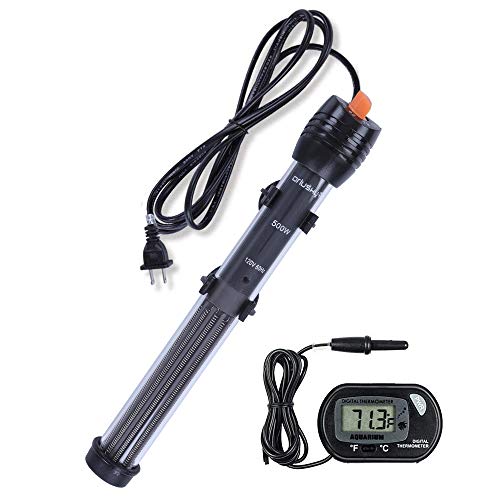
The 500W Orlushy heater is suitable for larger tanks (40–75 gallons) and features explosion-proof quartz glass and a 6-foot power cord. The adjustable thermostat enables precise control to maintain a stable temperature, while the rugged design helps protect both aquatic life and users. With two suction cups for secure mounting, this heater integrates easily into most glass or acrylic tanks and supports reliable performance in diverse water conditions.
HiTauing 50W/100W/200W/300W/500W Submersible Heater
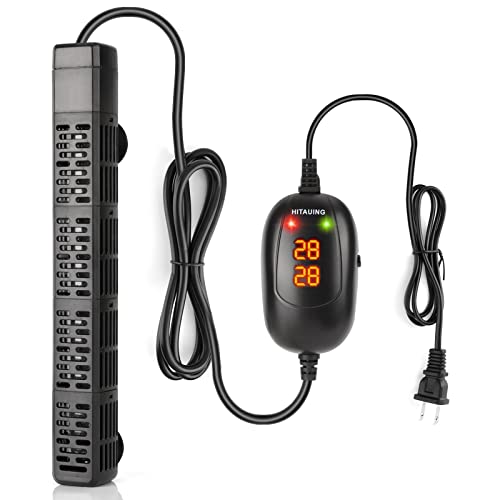
This HiTauing line provides a broader wattage range, including 50W to 500W. The intelligent temperature control supports Fahrenheit and Celsius, with over-temperature protection and automatic power-off when the water is leaving the tank surface or reaching the set temp. It uses explosion-proof quartz glass and a durable shell for safety and longevity. The range is designed for various tank sizes, from small to moderately large setups, making it flexible for seasonal changes or different aquaculture needs.
Buying Guide: Key Purchase Considerations and Comparisons
- Tank size and wattage compatibility: Choose a heater wattage that matches your tank volume. Underpowered units struggle to maintain temp, while oversized heaters may cause fluctuations or energy waste. Refer to the manufacturer’s recommended tank range for the best fit.
- Safety features: Look for explosion-proof quartz glass, over-temperature protection, and automatic shut-off when water level is insufficient. These features protect aquatic life and reduce risk to handlers.
- Temperature control and display: Digital LED controllers provide precise readings and easy adjustment. Dual-unit (F/C) capability is beneficial for users transitioning between systems or different species requirements.
- Durability and mounting: A robust ABS shell and reliable suction cups help the heater withstand daily aquarium use. Ensure the unit is submersible and designed for both freshwater and saltwater environments if needed.
- Ease of installation and maintenance: Simple knob-based adjustment or programmable controls shorten setup time. Consider wire length and cord management for clean tank setup and safety.
- Water safety and compatibility: Submersible heaters should be fully immersed to prevent overheating or leakage. Some models feature smart sensors that auto-stop if air or dry conditions are detected; this protects both fish and equipment.
- Maintenance and longevity: Look for ceramic or nickel-chromium heating elements and glass components rated for long-term use. Durable construction minimizes replacements and downtime.
- Saltwater vs. freshwater suitability: Some heaters cater specifically to one environment, while others are versatile across both. If you keep mixed tanks, confirm saltwater compatibility and corrosion resistance.
- Price vs. value: While price correlates with wattage and features, prioritize essential protections and reliable temperature control over cost for long-term aquarium health.