Choosing the right salt for a marine aquarium is essential for maintaining stable salinity, pH, and trace elements vital for corals and reef life. This guide highlights top salt mixes designed for reef and saltwater tanks, based on formulation, dissolution, and nourishing minerals. Read on to compare options and find the best fit for your system.
| Product | Brand | Type | Size |
|---|---|---|---|
| Instant Ocean Sea Salt | Instant Ocean | Sea Salt for Reef | 160 gallons |
| Instant Ocean Reef Crystals | Instant Ocean | Enriched Reef Salt | 160 gallons |
| Instant Ocean Reef Crystals | Instant Ocean | Enriched Reef Salt | 50 gallons |
| Instant Ocean Sea Salt | Instant Ocean | Sea Salt for Reef | 160 gallons |
| Instant Ocean Reef Crystals | Instant Ocean | Enriched Reef Salt | 160 gallons |
Instant Ocean Sea Salt For Marine Tanks
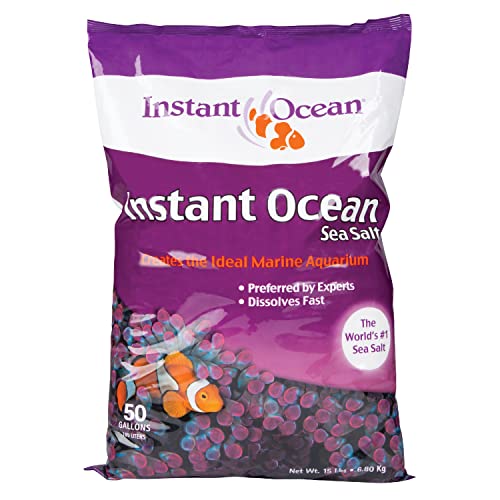
Instant Ocean Sea Salt is formulated specifically for marine aquariums, delivering essential major, minor, and trace elements needed by reef fish and invertebrates. It dissolves quickly, helping maintain stable salinity levels and a healthy buffered pH range for most reef setups. This salt is widely used for mixing large volumes, making it convenient for ongoing water changes.
Instant Ocean Reef Crystals Reef Salt

Reef Crystals Reef Salt includes essential ocean reef elements at concentrations higher than standard seawater, plus extra calcium and trace elements to support stony coral and coralline algae growth. It’s designed to promote vibrant corals while supporting a broad reef ecosystem, with reliable dissolution for uniform salinity across large tanks.
Instant Ocean Sea Salt (160 gal)

This 160-gallon sea salt mix is crafted to meet the needs of reef inhabitants with higher levels of calcium and trace elements. It aims to support coral growth and overall reef vitality. Proper mixing and gradual acclimation are recommended to minimize fluctuations and keep inorganic chemistry within target ranges.
Instant Ocean Reef Crystals Reef Salt

This 50-gallon option focuses on providing higher calcium and trace elements for smaller reef systems or incremental water changes. It supports healthy calcifying corals and robust invertebrate life by delivering a mineral-rich profile similar to natural seawater, tailored for periodic top-offs and partial changes.
API Aquarium Salt For Freshwater? Not Recommended Here

Note: This product is a freshwater salt mix and is not intended for marine or reef aquariums. For saltwater tanks, rely on reef-grade formulations such as Instant Ocean Reef Crystals or Sea Salt blends listed above to maintain appropriate alkalinity, salinity, and mineral balance.
Buying Guide for Saltwater Aquarium Salts
Key factors to consider when selecting a salt mix include the target salinity, reef-compatibility, calcium and magnesium content, alkalinity buffering, and trace elements. Reef-specific blends generally provide higher calcium for corals and enhanced buffering to stabilize pH. For new or small tanks, a ready-to-use mix with clear instructions can reduce guessing during water changes. Large systems benefit from mixes formulated for bulk dissolution and consistent density. Always acclimate salinity gradually to minimize stress on livestock and monitor parameters after changes.
What to look for in reef-focused salts
- Calcium and alkalinity balance to support coral growth
- Magnesium content to stabilize reef chemistry
- Trace elements such as strontium and iodine
- Low nitrate and phosphate levels to prevent algae blooms
- Solubility and clarity of the prepared solution
Choosing between reef crystals and sea salts
- Reef Crystals: Higher calcium and trace elements; ideal for coral-dominated systems
- Sea Salt: General marine compatibility; good for mixed communities
- Volume and frequency: Align with your water-change schedule to keep parameters stable
Practical tips for mixing and maintenance
- Use a dedicated mixing container, maintain aeration during dissolution
- Check salinity with a refractometer or accurate hydrometer after dissolving
- Allow the mixture to circulate before testing to ensure complete dissolution
- Test alkalinity, calcium, magnesium, nitrate, and phosphate regularly