Answering the search for powerful aquarium air pumps, this guide highlights top-performing models that deliver reliable oxygenation for mid-to-large tanks, hydroponic systems, and ponds. Each pick is evaluated for noise, airflow, durability, and ease of use. Best for hobbyists seeking high output, best for quiet operation, and best for multi-outlet setups are clearly explained so you can choose confidently.
| Product | Brand | Best For | Key Strength |
|---|---|---|---|
| AQQA Aquarium Air Pump (3W) | AQQA | Small to medium tanks up to 80 gallons | Compact power with dual outlets |
| AQUANEAT 300GPH Aquarium Air Pump | AQUANEAT | Medium to large tanks up to 200 gallons | Multiple outlets for multiple devices |
| hygger 4W Adjustable | hygger | Small to mid tanks; quiet operation | Low-noise design with adjustable flow |
| Uniclife 64 GPH Dual Outlet | Uniclife | 10–100 gallon tanks | Visible flow control with dual outlets |
| AQQA 10W/15W Powerful Aquairum Air Pump | AQQA | Ponds and large tanks up to 600–1000 gallons | High airflow and durable copper motor |
AQQA Aquarium Air Pump — Quiet Power for Medium Tanks

The AQQA 3W model is designed for stable performance with energy efficiency. It delivers up to 100 GPH and 18 kPa, suitable for tanks up to about 80 gallons. This pump uses a double-layer housing with four soft rubber pads to minimize vibration and noise, often under 35 dB. Best for: hobbyists seeking a quiet, compact pump for a single or two-tank setup. Limitation: airflow drops if used with long tubing or multiple long runs without adequate stone or diffuser sizing.
AQUANEAT 300GPH — Versatile For Up To 200 Gallons

The AQUANEAT pump provides 300 GPH with four outlets, making it ideal for running multiple air stones, sponge filters, or hydroponic aerators in larger tanks. It offers an adjustable airflow control and a compact 7.5 x 5.5 x 3.5 inch footprint. Best for: aquarists needing to power several devices simultaneously in larger tanks; better for setups that require distributed air without upgrading to multiple pumps. Caution: ensure tubing and stones are compatible with multiple outlets to optimize balance and avoid over-aeration in starter fish zones.
hygger 4W Adjustable — Quiet and Precise

This 4W hygger model balances power and quiet operation, delivering up to 95 GPH per outlet with a maximum of about 20 kPa. It supports tanks up to 120 gallons and uses a double-layer shell, thick ABS construction, and four rubber feet to minimize vibration. Best for: bedrooms, offices, and living spaces where quiet performance matters. Limitation: airflow may feel insufficient if the tank is significantly larger than 120 gallons or if tubing is restricted.
Uniclife 64 GPH Dual Outlet — Simple Dual-Outlet Control
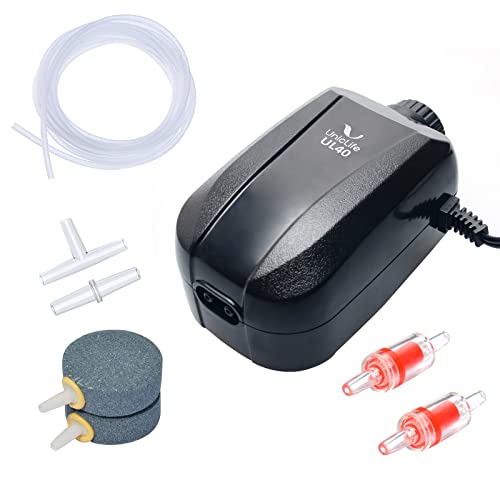
The Uniclife pump offers 64 GPH with two outlets, suitable for 10–100 gallon aquariums. It features a rotary knob for adjustable airflow and low-noise operation around 25 dB in low mode. Best for: simple, reliable aeration in smaller to mid-sized tanks without needing multi-device power. Caution: actual airflow can decrease if intake filter is clogged or if the air stones are obstructed.
AQQA 10W — High-Volume Aeration for Large Tanks

This 10W model delivers up to 237 GPH (10W) or 356 GPH (15W) with up to 0.026–0.03 MPa pressure, making it suitable for 600–1000 gallon setups. Built with a copper motor for durability and multiple adjustable outlets, it’s designed for demanding environments or outdoor ponds. Best for: large tanks or ponds where strong aeration is required; better for setups that demand sustained high airflow. Limitation: higher power draw and larger footprint may be less suitable for compact home aquariums.
Buying Guide: Key Considerations For Powerful Aquarium Air Pumps
- Tank size and aeration needs — Match pump capacity to the tank volume and desired oxygenation. Pumps with higher GPH and adjustable outlets excel in larger systems.
- Noise level — Look for double-layer construction, rubber feet, and vibration isolation. Quiet models are essential for bedrooms or offices.
- Outlets and accessories — Multi-outlet pumps simplify tubing, stones, and filters without needing multiple units. Check if the kit includes tubing, valves, or check valves.
- Durability and materials — Stainless steel or copper motors can improve longevity. Consider pumps designed for freshwater and marine use if both are present.
- Maintenance — Easy access to filters and intake elements reduces the risk of airflow loss. Availability of replacement parts matters for long-term use.
- Placement considerations — Ensure adequate distance from fish and avoid direct strong jets. Consider background noise and thermal heat output in room design.
Frequently Asked Questions
- What size pump do I need for a 100-gallon tank? — A pump delivering roughly 100–300 GPH with adjustable outlets is commonly suitable, depending on how many air stones or filters you run.
- Are quieter pumps less powerful? — Not necessarily. Some models balance quiet operation with substantial airflow through isolated housings and dampening features.
- Can I run multiple air stones off one pump? — Yes, if the pump has multiple outlets or a manifold system. Ensure total airflow capacity matches the sum of devices.
- Is stainless steel better for marine setups? — Stainless steel outlets and durable housings are advantageous for saltwater or brackish environments due to corrosion resistance.
- How often should I replace air stones? — Check industry guidelines and inspect stones for blockages or wear. Replace when airflow declines or stones crumble.
- Do high-wower pumps require special electrical considerations? — Handle with standard electrical safety; follow manufacturer guidelines for voltage and heat dissipation in enclosed spaces.