Answering your need for reliable marine water monitoring, these systems help track pH, salinity, temperature, and other critical parameters essential for reef tanks and saltwater fish. Ideal buyers include hobbyists building reef aquariums, professional aquaculture setups, and anyone who wants remote, continuous insight into their marine environment. The following selections cover multi-parameter sensing, WiFi connectivity, and easy calibration to support stable tank conditions. Below is a quick summary table of the chosen products.
| Product | Best For | Key Benefit |
|---|---|---|
| YINMIK 6-in-1 pH EC PPM WiFi Monitor | Hydroponics and marine tanks | Continuous, multi-parameter monitoring via app |
| Landtek Water Quality Tester | Home aquariums and ponds | 6-in-1 with online app data curves |
| TEKCOPLUS 6-in-1 Smart Water Quality Tester | Aquariums and hydroponics | Real-time WiFi with 30-day data view |
| Gain Express 5-in-1 WiFi Meter | Aquariums and pools | 5 parameters with Tuya APP and alerts |
| Industrial Test Systems ITS Exact iDip 570 | Marine aquaculture and research | Bluetooth-enabled, 7 parameters with digital readout |
YINMIK 6-in-1 pH EC PPM Monitor for Hydroponics
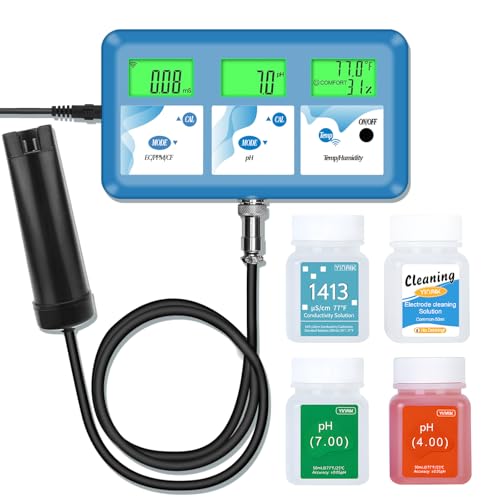
The YINMIK device combines pH, TDS/PPM, EC, CF, temperature, and humidity into a single WiFi-enabled probe. Best for hobbyists who want continuous, remote visibility of nutrient and tank conditions. This unit supports monitoring in nutrient solutions and marine setups where stable pH and salinity are critical. A single probe measures multiple parameters, simplifying maintenance.
Best for: Marine tanks and hydroponic setups that need consolidated data in real time. The app-based alerts help catch out-of-range nutrient levels. Caution: Precision depends on proper probe immersion and regular calibration; improper placement may affect readings.
Landtek Water Quality Tester (pH/EC/TDS/Salinity/SG/Temperature)

This tester offers six-in-one measurements with an online app view. It provides real-time data and 30-day data curves, enabling trend analysis for easier tank management. It’s suitable for households, hydroponics, ponds, and marine aquariums that require consistent water quality tracking. Calibration is streamlined for pH and EC, making it accessible for regular hobbyists.
Best for: Users who want a comprehensive, app-backed overview of multiple parameters. Caution: App features depend on device compatibility; ensure your phone and OS support the app.
TEKCOPLUS 6-in-1 Smart Water Quality Tester

The TEKCOPLUS device monitors pH, EC, TDS, salt, SG, and temperature with WiFi connectivity for mobile viewing. It supports 30-day data views, enabling easy comparison over time. Its calibration is straightforward, and the device is suitable for fish ponds, aquariums, and hydroponics. The app-based monitoring provides alerts for parameter deviations.
Best for: Aquariums and mariculture operations needing remote, continuous monitoring. Caution: Accuracy depends on proper ATC compensation and calibration routine adherence.
Gain Express 5-in-1 WiFi pH Meter Monitor
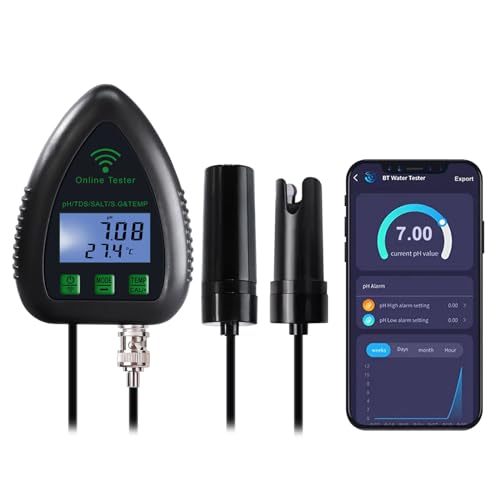
This 5-in-1 meter measures pH, TDS, salinity, SG, and temperature. Real-time wireless monitoring via Tuya Smart APP allows remote viewing and alerts when values fall outside preset ranges. It offers high precision with automatic temperature compensation and a straightforward calibration process.
Best for: Marine aquariums and hydroponics setups needing a compact, multi-parameter device with easy remote monitoring. Caution: The 5-parameter setup may not cover every niche test like ammonia or phosphate; consider adding a dedicated kit for those metrics.
Industrial Test Systems ITS Exact iDip 570 Marine Water Starter Kit
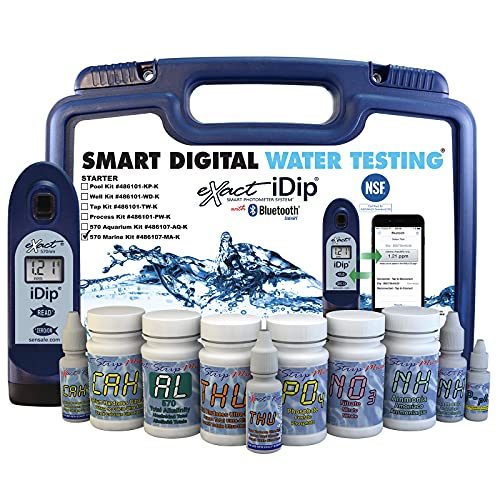
The ITS Exact iDip 570 offers a marine-specific starter kit with 7 parameters and a digital readout. It integrates with the eXact iDip app for iOS and Android, providing a structured approach to water testing. This option is best for dedicated marine setups and research contexts that require a comprehensive parameter set and digital logging.
Best for: Marine aquaculture and reef tank enthusiasts who need a boxed, multiplies-parameter testing solution. Caution: It comes with a learning curve due to the suite of tests; proper use is required to obtain consistent data.
Buying Guide
What should you look for when choosing a marine aquarium monitoring system?
- Number of parameters: Decide how many metrics you need to monitor (pH, salinity, TDS/EC, temperature, SG, ammonia, phosphate, etc.).
- Connectivity: Consider WiFi or Bluetooth options for remote access and data logging. App reliability matters for real-time alerts.
- Calibration: Look for easy, repeatable calibration steps and automatic temperature compensation to maintain accuracy.
- Data history: Prefer devices offering 14–30 days or longer data history to identify trends and seasonal shifts.
- Ease of use: For beginners, choose units with clear interfaces, simple setup, and straightforward maintenance schedules.
- Compatibility: Ensure the device suits marine tank salinity ranges and your tank size, whether reef setups or fish-only systems.
- Alarms and alerts: Real-time notifications help respond quickly to out-of-range conditions.
- Size and form factor: Consider whether a benchtop unit, inline sensor, or handheld tester best fits your tank layout.
FAQ
- Which monitoring parameters are most important for a marine aquarium?
Key parameters include pH, salinity (specific gravity), temperature, and dissolved nutrients (TDS/EC/PPM). These influence coral health, fish welfare, and overall stability.
- Is WiFi connectivity essential for marine monitoring?
WiFi enables remote access and alerts, which is valuable for busy hobbyists or budding reef systems. If you prefer offline readings, choose a non-WiFi model with local readouts.
- How often should I calibrate a multi-parameter monitor?
Calibrate according to the manufacturer’s guidance, typically weekly to monthly for accuracy, plus any time readings drift or after sensor replacement.
- Can these devices monitor multiple tanks at once?
Many models support multiple sockets or the ability to add several systems in one app. Check the product for multi-tank compatibility and how to manage several devices in the app.
- What’s the difference between pH meters and TDS/EC meters in marine setups?
PHS meters measure acidity/alkalinity, while TDS/EC meters estimate dissolved solids and conductivity. Salinity is a specific property in marine water, often tracked via SG or salinity meters.
- Should I use a single 6-in-1 device for my tank or separate sensors?
Single 6-in-1 units simplify setup and can be cost-effective, but separate sensors may offer higher precision for critical metrics like salinity and pH in large reefs.