Maintaining consistent feeding is essential for fish health, water quality, and aquarium aesthetics. The best fish tank auto feeders offer programmable schedules, adjustable portions, moisture protection, and flexible power options to keep fish fed on vacation or busy days. This article highlights high-review models and provides a practical buying guide to help you choose the right auto feeder for your setup.
| Product | Brand |
|---|---|
| Petbank Automatic Fish Feeder for Aquarium | Petbank |
| FISHNOSH Automatic Fish Feeder for Aquarium (Blue) | FISHNOSH |
| FISHNOSH Automatic Fish Feeder for Aquarium (ML) | FISHNOSH |
| Aoyar Automatic Fish Feeder | Aoyar |
| DXOPHIEX Automatic Fish Feeder | DXOPHIEX |
Petbank Automatic Fish Feeder for Aquarium

The Petbank model is designed to deliver precise portions with a moisture-resistant construction. Its 16-grid system supports up to 15 meals, with each grid holding about 2g, enabling a varied feeding plan. It offers two installation methods: an adjustable clamp base or a suction-cup option for tank covers. A fully sealed opening reduces moisture and jams, helping dry food stay fresh. It supports many food types, including pellets, powders, and small strips, though it’s not suitable for shrimp or flakes. A built-in LCD display aids setup and monitoring.
FISHNOSH Automatic Fish Feeder (Blue)

This auto feeder is built for simplicity and reliability, ideal for busy days or vacations. It supports up to nine feedings per day and can be calibrated for up to three rounds per day. The included setup directions simplify operation, and users can refill without removing the unit. Although it lacks a dedicated display, the straightforward controls make it accessible for households and even younger family members responsible for feeding. It’s suitable for a range of small to medium tanks and helps maintain a steady routine for residents.
FISHNOSH Automatic Fish Feeder (ML)

This model emphasizes a simple, user-friendly experience with up to three feedings daily and a straightforward refill process. While it does not feature a display screen, its reliable timing and small footprint make it suitable for bettas and other small fish. It is designed for easy use during travel or short absences, helping maintain routine without requiring complex programming.
Aoyar Automatic Fish Feeder

The Aoyar feeder emphasizes adjustable portions and moisture protection. It features three fixed feeding modes with interval choices of 8, 12, or 24 hours. A 200 ml capacity supports longer vacations. An updated moisture-proof lid minimizes moisture ingress, reducing clumping and keeping food dry. The device also allows manual feeding, giving hobbyists flexibility for immediate meals. Its dual mounting options satisfy tanks with or without hoods.
FISHNOSH Automatic Fish Feeder with Digital Thermometer
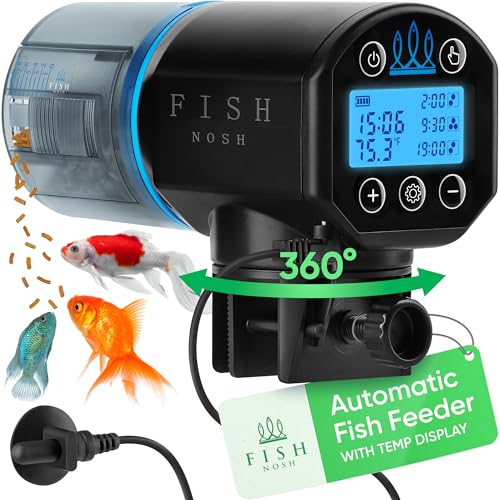
Designed for versatile aquariums of varying sizes, this feeder lets you set up to three daily feedings with adjustable portions. A built-in digital thermometer adds a health-monitoring layer, sending audible alerts if water temperature drifts outside a safe range. This feature is helpful for maintaining stable conditions during extended absences. The dispenser supports multiple feeding frequencies and is intended for both everyday use and vacations, balancing convenience with animal care considerations.
DXOPHIEX Automatic Fish Feeder

DXOPHIEX offers a flexible feeding schedule with options for automatic cycles every 8, 12, or 24 hours, plus manual feeding when needed. It supports two power sources: batteries and USB power, with a 6.6-foot USB cable included. The device provides two fixing methods—edge mounting and hood mounting—so it fits a range of tank configurations. This versatility makes it suitable for investors in diverse aquarium setups or for users who may experience power interruptions.
Buying Guide: Key Considerations For Choosing A Fish Feeder
- Feeding schedule and capacity: Determine how many meals per day you need and whether the feeder supports multiple daily feedings (some offer 3–9 feedings or more). Consider capacity in milliliters or grams if you keep larger portions or longer vacations.
- Portion control: Look for adjustable portion sizes to prevent overfeeding, which can cause water quality issues. Some feeders have grid-based portions for precise dosing, while others offer more general adjustments.
- Power options: Battery-powered feeders are reliable during outages, while USB-powered models offer long-term convenience. Dual power sources can provide extra reliability for vacation use.
- Moisture protection: Moisture-proof lids and sealed compartments reduce clumping and jams, especially for powders and pellets. This is crucial in humid environments or with flaky foods.
- Installation compatibility: Check mounting options—edge clips, tank covers, or hood mounting—to ensure the feeder fits your aquarium’s design and lid type.
- Food compatibility: Ensure the feeder supports your specific food type (pellets, flakes, powders, or strips). Some devices are not suitable for certain foods or species (e.g., shrimp).
- Ease of use: A clear display and simple controls shorten setup time and minimize user error. For households with kids, a straightforward interface can be a benefit.
- Additional features: Look for extras such as built-in thermometers or manual feeding modes, which can provide added value for monitoring tank conditions and timely feeding.
In selecting an auto feeder, balance the features with your tank size, fish species, and travel frequency. A moisture-resistant model with adjustable portions, reliable power options, and versatile mounting will typically deliver the best long-term performance. If you keep small to medium fish in a standard glass or acrylic tank, a compact, easy-to-use unit with clear instructions may be the most practical choice. For larger setups or holiday care, models with higher meal counts and robust build quality may be worth the investment.