Keeping aquarium water at a stable temperature is essential for fish health and plant growth. This guide highlights top external submersible heaters designed for safe operation, precise temperature control, and reliable durability across freshwater and saltwater setups. Explore five highly compatible options, with quick feature highlights and practical buying tips to help you pick the right heater for your tank size and species.
| Product | Recommended Tank Range | Key Benefit |
|---|---|---|
| Orlushy 300W Submersible Heater | 40-60 gallons | Strong heat output with safety cutoffs |
| Orlushy 100W Submersible Heater | 10-20 gallons | Compact, easy concealment |
| hygger 800W Aquarium Heater | 80-220 gallons | Digital LED controller, multi-protection |
| AQQA Submersible Heater (200W–1200W variants) | various sizes | External thermometer and LED controller |
| HiTauing 300W Upgrade | 40-75 gallons | Intelligent leaving-water stop and temperature control |
Note: All models shown maintain consistent warmth for both freshwater and saltwater environments. Each option includes a durable quartz glass tube, safety features to prevent overheating, and a digital or external controller for precise adjustments. The sections below summarize five representative products to help you compare capabilities and fit for your aquarium.
Orlushy 300W Submersible Aquarium Heater

Designed for medium-sized tanks, the Orlushy 300W heater covers 40-60 gallons in both freshwater and saltwater setups. Its compact 8.6-inch form fits neatly in many aquariums, helping to preserve tank aesthetics while delivering steady heat. The heater uses gray quartz glass for enhanced hardness and explosion resistance, improving durability in diverse environments. A premium nickel-chromium heating element ensures rapid warming and even heat distribution, with a real-time temperature sensor that maintains the set value. When temperature nears 95°F, the unit automatically cuts power, triggering an EE error code to warn of overheating risks. This model emphasizes safety and dependable performance for community tanks and species with narrow thermal tolerances.
Key features include: compact size for easy hiding, quartz glass construction for durability, rapid heating with accurate temperature sensing, and automatic cut-off above the set temperature to protect aquatic life. The external controller and thermometer bundle simplify monitoring, reducing the need for additional equipment. Use this heater with confidence in home aquariums that require stable heat within the 70–85°F range depending on species.
Orlushy 100W Submersible Aquarium Heater

The Orlushy 100W heater is ideal for smaller tanks, typically 10-20 gallons. With a compact 5.3-inch body, it blends into the aquascape without intruding on aesthetics. The quartz glass construction provides safety through high-temperature resistance and explosion-proof properties, suitable for both freshwater and saltwater usage. A precise water sensor and nickel-chromium heating element offer efficient, uniform heating and temperature stability, while automatic shut-off occurs if water levels drop or temperatures exceed the set point—reducing the risk of overheating and fish stress.
Core benefits include a slim footprint, reliable temperature control, and built-in safety protections that make it a practical choice for nano tanks, Betta tanks, and small community setups. It supports steady temperatures in the low-to-mid 80s Fahrenheit range depending on species with straightforward maintenance and long-term durability.
hygger 800W Aquarium Heater

The hygger 800W heater is designed for larger tanks, recommended for 80-220 gallons. It features a digital LED controller that displays live temperature, preset values, and power status, with a long power cord for flexible placement and bracket mounting. Safety protections include overheat and out-of-water alarms, with automatic shutoff when temperatures reach 94°F or when the water level falls below the required submerged depth. The unit uses an explosion-proof quartz glass tube and a nickel-chromium heating element for quick, consistent heating and extended service life. This model is well suited for marine or freshwater aquariums that require precise heat management and robust protection systems.
Strengths include a broad temperature range (approximately 59–93°F), clear visibility of current vs. target temperatures, and multi-layer safety features. The primary consideration is tank size and whether you prefer digital control on the heater itself or a wall-mountable external control unit for easier access outside the tank.
AQQA Submersible Aquarium Heater (200W–1200W)
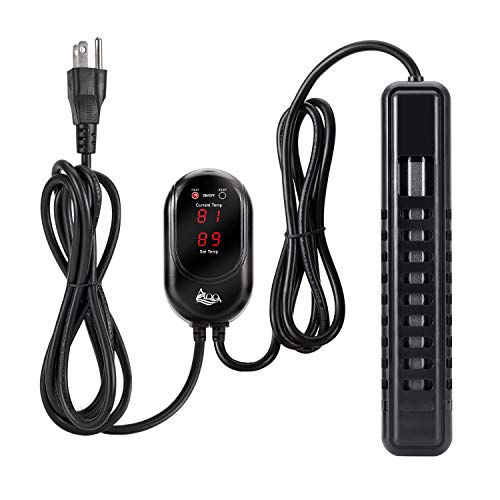
The AQQA heater line provides a range of wattages from 100W up to 1200W, making it adaptable to many tank sizes. The device uses explosion-proof quartz glass and a robust nickel-chromium heating wire for efficient, safe heating. The external LED controller shows both current water temperature and the target setting; the unit also provides a Celsius-to-Fahrenheit toggle for user convenience. The design emphasizes quick heating (about 2 hours per degree Celsius in optimal conditions) and reliable operation with a protective outer shell to minimize the risk of scalding. The controller is not fully waterproof, so it should be placed outside the water path to maintain safety.
Considerations when choosing AQQA include available wattage options for your tank size, how you prefer to monitor temperature (external vs. inline display), and whether you need quick response times for rapid temperature changes. This line is versatile for mixed aquariums where species require specific, stable temperatures.
HiTauing 300W Upgrade Aquarium Heater
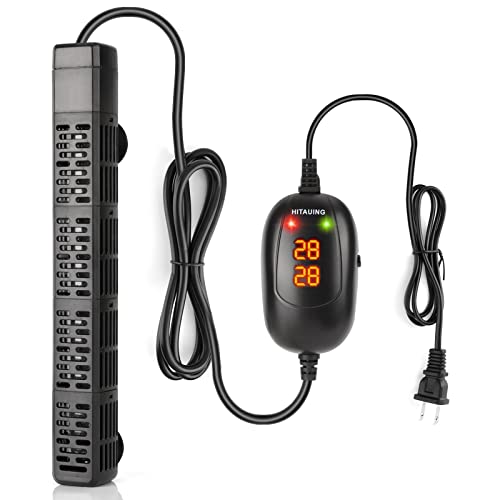
This upgraded 300W model is designed for 40-75 gallon tanks. It features explosion-proof quartz glass and a robust ABS shell for added safety and concealment. The heater uses nickel-chromium heating wire to achieve rapid, uniform heating and provides a wide temperature range (63–94°F). A standout feature is the intelligent leaving-water protection system, which automatically stops heating when the heater head is out of water by about 5 cm. The unit includes a large digital display and a control dial for easy temperature adjustments. Multiple safety alerts help prevent overheating and dry burning, contributing to a safer aquarium environment for fish and invertebrates alike.
Choosing HiTauing involves balancing tank size, desired temperature range, and the importance of auto-stop protections. The model is well-suited for hobbyists who prioritize straightforward operation and dependable shutoff behavior during water level fluctuations or when the tank is dechlorinated or transitioning.
Buying Guide: Key Purchase Considerations
- Tank size and wattage: Choose a heater with an appropriate wattage for your aquarium volume. Larger tanks typically need higher-watt or multiple heaters to maintain stable temperatures.
- Temperature range and accuracy: Look for units offering a practical range (roughly 63–94°F) and ±1–2°F accuracy for precise control. Digital controllers or external displays simplify adjustments.
- Safety features: Overheat protection, out-of-water sensors, and auto shut-off are essential to prevent harm to fish and corals. Quartz glass construction adds durability in varied water conditions.
- Controller type: Decide between built-in digital displays on the heater and external controllers. External controllers can be easier to reach without opening the tank, especially in planted or complex setups.
- Submersion and placement: Ensure the heater design supports full submersion where required. Some models include brackets or adjustable sensors for optimal placement.
- Maintenance considerations: Quartz glass is durable but still requires periodic inspection for mineral buildup. Ensure the unit is easy to clean and inspect.
- Saltwater vs. freshwater: Most listed models are rated for both. If you keep delicate species, verify that the heater tolerates salinity and mineral content without corrosion.
- Redundancy: For valuable or sensitive aquariums, consider a backup heater or dual-heater setup to maintain temperature if one unit fails.
When selecting, compare compatibility with your tank’s glass thickness, décor, and access points. Read user reviews for real-world performance data, especially regarding how quickly the heater responds to temperature changes and how reliably the display reflects actual water temperature.