Looking for affordable, reliable, and effective reverse osmosis water filtration for your aquarium? The following selections focus on budget-friendly RO/DI systems that deliver solid filtration performance without breaking the bank. Each option balances cost, ease of installation, and filtration quality to help you maintain pristine tank water.
| Product | Brand | GPD | Notes |
|---|---|---|---|
| Aquatic Life RO Buddie 4-Stage | Aquatic Life | 50 | 4-stage filtration; strong overall performance for aquariums |
| Geekpure 3 Stage Portable RO | Geekpure | 100 | Compact 3-stage design; versatile for aquariums and home use |
| Aquatic Life Twist-In 4-Stage | Aquatic Life | 75 | Twist-in unit; solid filtration with 75 GPD capacity |
| Geekpure 4 Stage Portable RO | Geekpure | 100 | Four-stage system with DI; high purity water |
| Aquatic Life RO Buddie 3-Stage | Aquatic Life | 50 | Budget-friendly 3-stage filtration; easy setup |
Aquatic Life RO Buddie 4-Stage RO System

Quality filtration is the core of this 4-stage Aquatic Life setup. It produces up to 50 gallons per day (GPD) of filtered water, suitable for many standard freshwater and reef aquariums. The RO membrane reduces Total Dissolved Solids (TDS) very effectively, and a sediment stage helps remove particulates that can cloud water and stress aquatic life. Its compact footprint makes it a practical fit for home setups with limited space. Installation is straightforward for hobbyists building their first RO/DI system, and the unit’s 50 GPD output is enough for frequent water changes without excessive waste.
Geekpure 3 Stage Portable RO System

This 3-stage Geekpure system is designed to deliver clean aquarium water with a compact form factor. It filters down to 0.0001 micron and reduces a wide range of contaminants like heavy metals, fluoride, and arsenic. It’s marketed for both aquarium and residential use, offering a cost-effective path to high-quality water. It supports a robust output suitable for smaller to mid-sized tanks, and the system emphasizes easy installation and simple maintenance through quick-connect fittings. The 1:2 pure-to-waste ratio is a typical characteristic of many RO systems, and flushing new filters for 30 minutes is advised to ensure optimal performance at start-up.
Aquatic Life Twist-In 4-Stage RO System
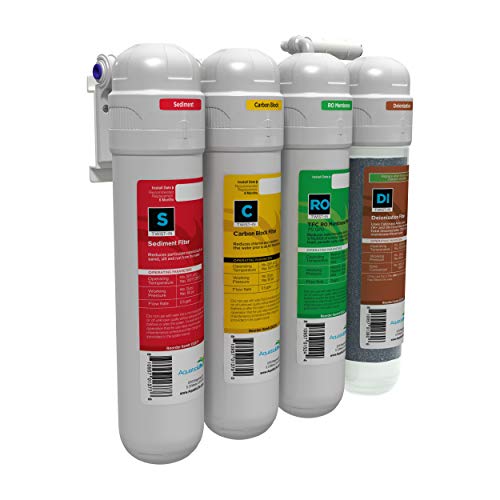
The Twist-In 4-stage unit from Aquatic Life combines a 75 GPD output with reliable membrane filtration to reduce TDS effectively. Sediment removal helps improve water clarity, while the compact design aids in installations with limited space. It’s designed for aquariums that demand consistent water quality, and the 75 GPD rate ensures you can perform regular water changes without long waits. The Twist-In design can simplify service and cartridge replacement, making ongoing maintenance manageable for hobbyists and operators alike.
Geekpure 4 Stage Portable RO with DI

This Geekpure model expands to a four-stage system and adds a deionization (DI) stage for near-zero TDS. The DI filter helps achieve ultrapure water, which can be beneficial for sensitive reef tanks or systems with strict water quality requirements. It maintains a 100 GPD capacity, which is helpful for larger water changes or higher-frequency setups. Quick connections and clear instructions support DIY installation and maintenance, while the overall design emphasizes portability and versatility for various uses beyond aquariums as well.
Aquatic Life RO Buddie 3-Stage

This budget-friendly 3-stage option from Aquatic Life delivers up to 50 GPD with essential filtration to reduce TDS effectively. It focuses on affordability without sacrificing core RO benefits such as membrane filtration and sediment removal. The 3-stage configuration keeps installation straightforward and maintenance manageable for hobbyists who want dependable water quality without a larger upfront investment.
Aquatic Life RO Buddie 3-Stage Hydroponic Unit

This version emphasizes hydroponic use but remains relevant for aquarium enthusiasts seeking reliable RO filtration on a budget. It offers a 3-stage RO configuration with solid TDS reduction and a practical design that accommodates smaller spaces. The unit’s compact footprint makes it suitable for apartments or rooms with limited counter space, while still delivering the clean water needed for hobbyist tanks.
Buying Guide: Key Purchase Considerations For Budget RO Systems
- Filtration stages and TDS reduction: More stages (RO, sediment, DI) typically improve water purity. For budget setups, 3- to 4-stage systems are common and adequate for most aquariums.
- GPD capacity: Choose a rate that matches your water-change schedule. 50–75 GPD suits many hobbyists, while 100 GPD models offer faster production for larger tanks or frequent water changes.
- Space and installation: Compact, under-sink or countertop units with quick-connect fittings simplify setup and maintenance and save space in tighter living areas.
- DI inclusion and resin visibility: DI stages can push TDS to near-zero levels, which is beneficial for sensitive setups. Visible resin indicators help track replacement needs.
- Wastewater ratio: Most RO systems waste water; a typical ratio is around 1:1 to 1:2 (pure water to waste). Consider systems with efficient waste management if water usage is a concern.
- Maintenance and filter availability: Check replacement cartridge availability and ease of filter changes. Brands with widely available replacements help lower ongoing costs.
- Build quality and brand reputation: Established brands with aquarium-focused filters often provide better reliability and customer support, which is valuable for hobbyists.
- Application scope: While primarily for aquariums, many of these units can be used for hydroponics or drinking water when filtered water purity is required, offering versatility.
When selecting a budget RO solution, balance upfront cost with ongoing maintenance and water quality needs. For most hobbyists, a 3- to 4-stage system with 50–75 GPD capacity provides reliable filtration for standard freshwater and many reef setups. If you maintain larger tanks or higher water-change frequencies, a 100 GPD model could reduce wait times for production. Always verify compatibility with your tank’s needs and your local water quality to ensure the best results.