Automating water changes and top-offs helps maintain stable water parameters, reduce manual labor, and support healthier freshwater tanks. Below, five top ATO (automatic top-off) systems are highlighted for versatility, safety, and reliability. Each entry covers how the device works, key features, and how it fits different tank setups—from small desktop tanks to larger displays.
| Product | Brand | What It Does | Approx. Tank Fit |
|---|---|---|---|
| Miofis ATO NG ONE | Miofis | Dual optical sensors, controller-less design, safety sensors | Freshwater to reef-ready tanks |
| ATET Auto Top Off System | ATET | QST Smart Technology, dual anti-overflow, real-time protection | Small to medium freshwater and reef setups |
| FZONE ATO 2.0 | FZONE | Dual sensors, precision monitoring, overfill protection | Rimmed or rimless tanks |
| MagTool ATO Lite | MagTool | Dual optical sensors, compact 0.8″ footprint, safety safeguards | All tank sizes |
| Qwakay Auto Top Off System | Qwakay | Smart alarm, 12V operation, simple setup | Intimate sump or nano systems |
Miofis ATO NG ONE Auto Top Off System

The Miofis ATO NG ONE is designed for both reef and freshwater tanks with a focus on long-life reliability. Its dual optical sensors detect water level changes accurately, while a shielded design minimizes interference from air bubbles. A controller-less approach simplifies operation and reduces potential failure points, contributing to lower maintenance. A dedicated safety point above the probe center ensures the system stops automatically if water levels rise unexpectedly, protecting sensitive inhabitants and equipment.
ATET Auto Top Off System
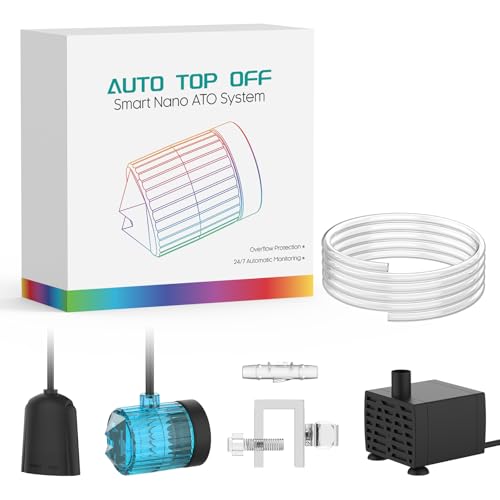
ATET’s ATO system emphasizes real-time protection and stable water parameters through dual anti-overflow safeguards. With QST Smart Technology, it operates around the clock to maintain consistent water levels, helping to prevent salinity swings and parameter drift—crucial for reef systems and freshwater tanks alike. Its ultra-compact nano optical sensor allows easy integration into compact setups while maintaining reliable performance in larger displays.
FZONE Aquarium ATO 2.0 System

FZONE’s 2.0 ATO system focuses on dependable water level maintenance for both saltwater and freshwater tanks. Its compact design with a 0.79-inch optical sensor fits rimmed, rimless, or sump configurations. Dual sensors spaced 0.1 cm apart monitor levels with tight tolerance, maintaining a typical 0.6 cm difference. QST 2.0 safety features provide real-time overfill protection and alarm triggers if refill exceeds preset limits or sensor status indicates an issue, making it suitable for tanks with occasional water movement.
MagTool ATO Lite

The MagTool ATO Lite features dual high-precision optical sensors for accurate replenishment and overfill prevention. Its micro footprint (0.8 inches) allows unobtrusive placement in tanks with limited space, including rimmed and rimless designs. A built-in safety algorithm analyzes tank size at startup to tailor refill timing and safeguard against accidental overfills, making it a practical option for busy setups and unattended maintenance.
Qwakay Auto Top Off System

The Qwakay Smart ATO System emphasizes safety and simplicity. It features a 12V operation for energy efficiency and reduced risk, along with an intelligent alarm system to indicate bucket depletion, leaks, stuck floats, or pump issues. The setup is straightforward—sensor, submersible pump, and controller—making it suitable for smaller sumps or nano tanks while still supporting larger systems via scalable components.
Buying Guide: Key Considerations For Choosing An ATO System
- Tank size and configuration: Rimmed, rimless, and sump setups affect sensor placement and mounting options. Choose a model with a compact sensor and flexible installation.
- Sensor type and safety: Dual optical sensors reduce false triggers and overfill risks. Look for protective shields and automatic shutoffs when water exceeds safe levels.
- Overflow protection: Real-time monitoring and alarm features help prevent spills. Systems with auto-stop mechanisms are preferable for unattended operation.
- Ease of installation: A straightforward setup with minimal components decreases troubleshooting time. Consider pre-wired kits and clearly labeled connections.
- Power requirements: Many units operate at 12V or standard mains voltage. Check compatibility with your power supply and surge protection considerations.
- Maintenance and longevity: Materials that resist corrosion and ease of sensor cleaning extend lifespan. Look for sealed housings and durable seals.
- Maintenance frequency: Some units require periodic recalibration or sensor cleaning—factor in routine checks for reliable performance.
- Water source and replenishment: Ensure the reservoir design fits your space and that the system accounts for water level fluctuations in your tank.
These products provide a range of options from ultra-compact nano setups to larger displays, all aimed at stabilizing freshwater tanks with automated water balancing. When selecting, consider tank dimensions, stocking, and how often you travel or are away from home, as these factors influence how robust and autonomous your ATO system needs to be.