Choosing a quiet aquarium air pump helps maintain a tranquil home or office aquarium while providing essential aeration for fish and plants. The following profiles spotlight five top-performing models from trusted brands, balancing low noise with dependable airflow. This guide covers efficiency, adjustable settings, dual outlets, and suitability for various tank sizes—from small nano tanks to large installations.
| Product | Brand | Max Airflow (GPH) | Noise Level | Tank Range |
|---|---|---|---|---|
| AQQA Aquarium Air Pump | AQQA | Up to 100 | ≤35 dB | Up to 200 gallons |
| hygger Aquarium Air Pump (4W/7W/11W) | hygger | Up to 180-360 L/H per channel | ≤35 dB | Up to 120 gallons |
| Uniclife 64 GPH Dual Outlet | Uniclife | 64 GPH | 25-45 dB | 10-100 gallons |
| NICREW Nano Silent | NICREW | 0.3 L/min | Virtually silent | Up to 10 gallons |
| INCLY 7W Ultra Silent | INCLY | 245 GPH | Ultra quiet | Large aquariums & hydroponics |
The selections below highlight five models that deliver quiet operation, solid airflow, and reliable construction. Each entry provides a quick overview of features and practical use cases to help you compare options quickly.
AQQA Quiet Dual Outlet Air Pump

The AQQA air pump provides up to 100 GPH with a maximum pressure of 18 Kpa and features a durable stainless steel dual-outlet design. It includes a robust, double-layer shell and four soft rubber pads to minimize vibration and noise, with a noise cap not exceeding 35 dB. It is suitable for connecting to a variety of air stones and can be used in freshwater or seawater setups. The unit is designed for energy efficiency while delivering stable output for tanks up to 200 gallons when configured with appropriate air stones.
hygger Quiet Adjustable Air Pump — 4W/7W/11W

The hygger line offers multiple wattages with dual stainless steel outlets and adjustable airflow. This pump family can deliver up to around 95 GPH per channel (total around 190 GPH on twin outlets) with a max pressure near 20 Kpa. It’s known for its quiet operation—delivering sound levels around 35 dB—and is suitable for tanks up to about 120 gallons. The adjustable knob lets you tailor airflow for bioload, plant density, or hydroponic needs, making it versatile for many setups.
Uniclife 64 GPH Dual Outlet Pump
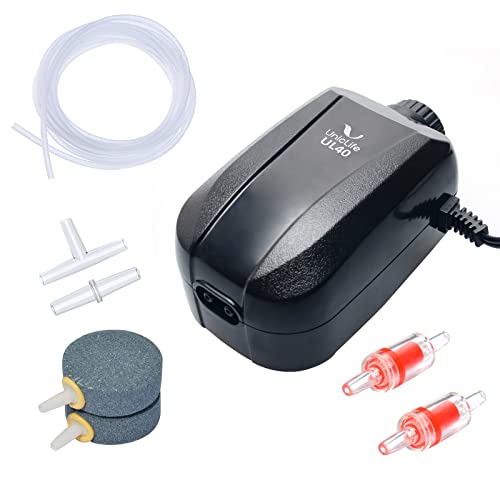
The Uniclife model delivers a steady 64 GPH with dual outlets and a rotary knob to adjust airflow. It is designed for 10–100 gallon tanks and includes check valve and connectors to support a reliable aeration setup. The unit operates quietly, with noise levels in the mid-range for market options (about 25–45 dB depending on airflow). This makes it a practical choice for mid-sized freshwater or marine tanks seeking consistent oxygenation without excessive noise.
NICREW Nano Silent Aquarium Air Pump

The NICREW Nano Silent pump is designed for ultra-quiet performance in small tanks. It is capable of pumping up to about 0.3 L/min (roughly 18 L/hr), making it ideal for up to 10-gallon tanks. Built for low-noise operation, its piezoelectric-driven mechanism minimizes audible vibration, allowing for peaceful viewing in bedrooms or offices. Suitable for both freshwater and saltwater setups, it’s a compact, energy-efficient choice for nano aquariums.
HITOP Dual Outlet Whisper Air Pump

The HITOP model delivers two outlets and adjustable airflow in a compact 3W design suitable for 10–100 gallon tanks. Its ABS plastic housing and soft rubber feet help dampen noise and vibration, contributing to a quieter tank environment. Built for reliability, the HITOP pump emphasizes long service life with a simple mechanical adjustment for airflow, making it a practical choice for home aquariums that require flexible aeration across varied tank sizes.
INCLY 7W Ultra Silent Air Pump

The INCLY 7W unit is built for larger aquariums or hydroponics, delivering up to 245 GPH with a 0.025 MPa air pressure. It is designed to operate above water level to prevent backflow, and features a hi/low speed switch for quiet operation. The design emphasizes energy efficiency and low noise, making it suitable for plant-rich setups or large tanks up to aquarium and hydroponic applications where consistent aeration is critical.
Buying Guide: Key Purchase Considerations
- Tank size and airflow needs: Larger tanks require higher airflow and often dual outlets to distribute air evenly. Match the pump’s maximum GPH (or L/H) to your tank’s volume for effective aeration.
- Noise levels: Look for units advertised with “quiet” or “silent” operation and check decibel ratings. Double-layer housings, rubber feet, and vibration-damping designs reduce noise significantly.
- Outlets and accessories: Dual outlets enable multiple air stones or media, improving water circulation and oxygen exchange. Check included tubing, check valves, and stones compatibility.
- Power and efficiency: Energy-efficient models save electricity over time. Consider pumps with adaptable airflow control for different bioloads and plant densities.
- Durability and materials: Stainless steel or reinforced housings tend to resist corrosion in saltwater setups. Durable diaphragms and motors reduce maintenance needs.
- Placement and safety: Ensure the unit can be positioned above the water line if required, and use check valves to prevent back-siphoning. Follow manufacturer guidelines for submersible or inline use.
- Maintenance: Availability of replacement parts, such as diaphragms or tubing, and the ease of cleaning can affect long-term performance.
- Hydroponics compatibility: Pumps rated for higher airflow and stable pressure can support aeration needs in hydroponic systems beyond typical aquariums.
When selecting a quiet aquarium air pump, prioritize stability, noise considerations, and compatibility with your tank size and type. The models listed above offer a range of airflow capacities and noise profiles, enabling informed decisions for peaceful, healthy aquaria.